
What is Carbon Footprint?
How Small Daily Habits & Enterprise Operations Impact the Planet
A carbon footprint measures the total volume of greenhouse gases released into the atmosphere from our direct and indirect activities. From driving a petrol vehicle and running air conditioning to industrial manufacturing and global supply chains, every human action creates a measurable carbon trail.
Interactive Infographic Series
Official EnviroWealth Visual Deck • 6 Infographic Cards
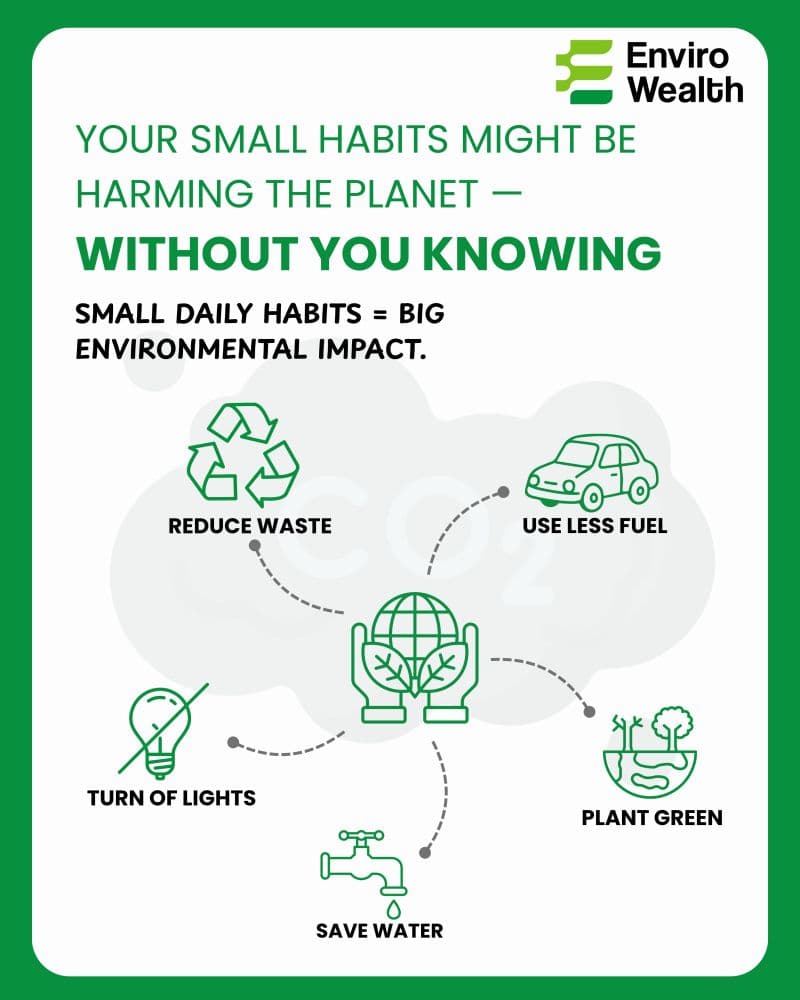
Your Small Habits Might Be Harming the Planet
Without You Knowing: Small Daily Habits = Big Environmental Impact
Daily routines like lighting, water consumption, commuting, and packaging waste quietly accumulate into substantial environmental burdens.
Select Card to Inspect:
Direct vs. Indirect Emissions: Understanding the Spectrum
To understand your footprint, you must distinguish between emissions you directly control and those you trigger indirectly through consumption:
- Direct Emissions: Emissions originating from sources you own or directly operate. For a household, this includes burning LPG for cooking or petrol in your vehicle. For an enterprise, it includes diesel generators and factory boilers.
- Indirect Emissions: Emissions resulting from your consumption of goods and services produced elsewhere. The electricity powering your lights comes from a utility that burned coal or gas. The clothes you wear required agricultural energy, manufacturing, and international freight.
The Physics of Impact: From Carbon to Climate Risk
Atmospheric greenhouse gas accumulation is not an abstract concept—it is a physical process with compound economic and planetary repercussions:
- Thermal Forcing: Greenhouse gases absorb longwave infrared radiation that would otherwise escape into space, steadily raising the global equilibrium temperature.
- Extreme Weather Anomalies: Warmer air holds 7% more moisture per degree Celsius, amplifying cloudbursts, severe flooding, and unseasonal cyclones.
- Agricultural Vulnerability: Extreme heatwaves and erratic monsoon schedules disrupt staple crop yields (wheat, rice), intensifying supply chain inflation.
- Sea Level Rise: Thermal expansion of oceans and polar ice sheet melt threaten coastal urban infrastructure and industrial trade corridors.
Four Operational Levers for Footprint Abatement
Both individuals and commercial organizations can deploy immediate, high-impact strategies across four core functional areas:
- Clean Mobility: Prioritize electrified transport, public transit integration, and route optimization to slash high-intensity Scope 1 fuel emissions.
- Renewable Energy Transition: Shift corporate power procurement toward rooftop solar, open-access renewable Power Purchase Agreements (PPAs), and Green Energy Open Access.
- Material Circularity: Eliminate single-use disposables, institute rigorous scrap recycling, and design products for disassembly and refurbishment.
- Ecological Sequestration: Invest in certified nature-based carbon sinks, local afforestation initiatives, and biodiversity restoration corridors.
Key Strategic Takeaways
Every product, service, and lifestyle action carries an embodied carbon value.
Routine actions like a 10 km drive (2.3 kg CO₂e) or 1 hour of air conditioning (1.5 kg CO₂e) quickly total tonnes of annual emissions.
Direct emissions (Scope 1) happen on-site, while indirect emissions (Scope 2 & 3) represent the bulk of modern carbon footprints.
Reduction must always precede offsetting in credible corporate climate strategies.
Digital footprint tracking enables data-driven decisions that cut operating expenses while minimizing environmental harm.
Calculate Your Footprint with EnviroWealth
Measure your personal or business footprint with our precision calculator tools tailored specifically for Indian operational environments.
Explore Related Topics
Know the Carbon Terms
Foundational Carbon Glossary Shaping ESG, Exports & Global Trade
What is PCF? (Product Carbon Footprint)
Cradle-to-Grave Lifecycle Emissions Accounting for Modern Supply Chains
What is EU's CBAM?
The EU Carbon Border Adjustment Mechanism & Strategic Exporter Guide