What is BRSR Core?
SEBI's Mandatory ESG Reporting Framework & The MSME Supply Chain Ripple Effect
Issued by the Securities and Exchange Board of India (SEBI) under Regulation 34(2)(f) of the LODR Regulations, the Business Responsibility and Sustainability Report (BRSR) is mandatory for India's top 1,000 listed companies. Through BRSR Core, SEBI requires auditable assurance across 9 key ESG metrics. Crucially, large corporations must report supply chain sustainability, directly impacting thousands of MSME suppliers across India.
Interactive Infographic Series
Official EnviroWealth Visual Deck • 6 Infographic Cards
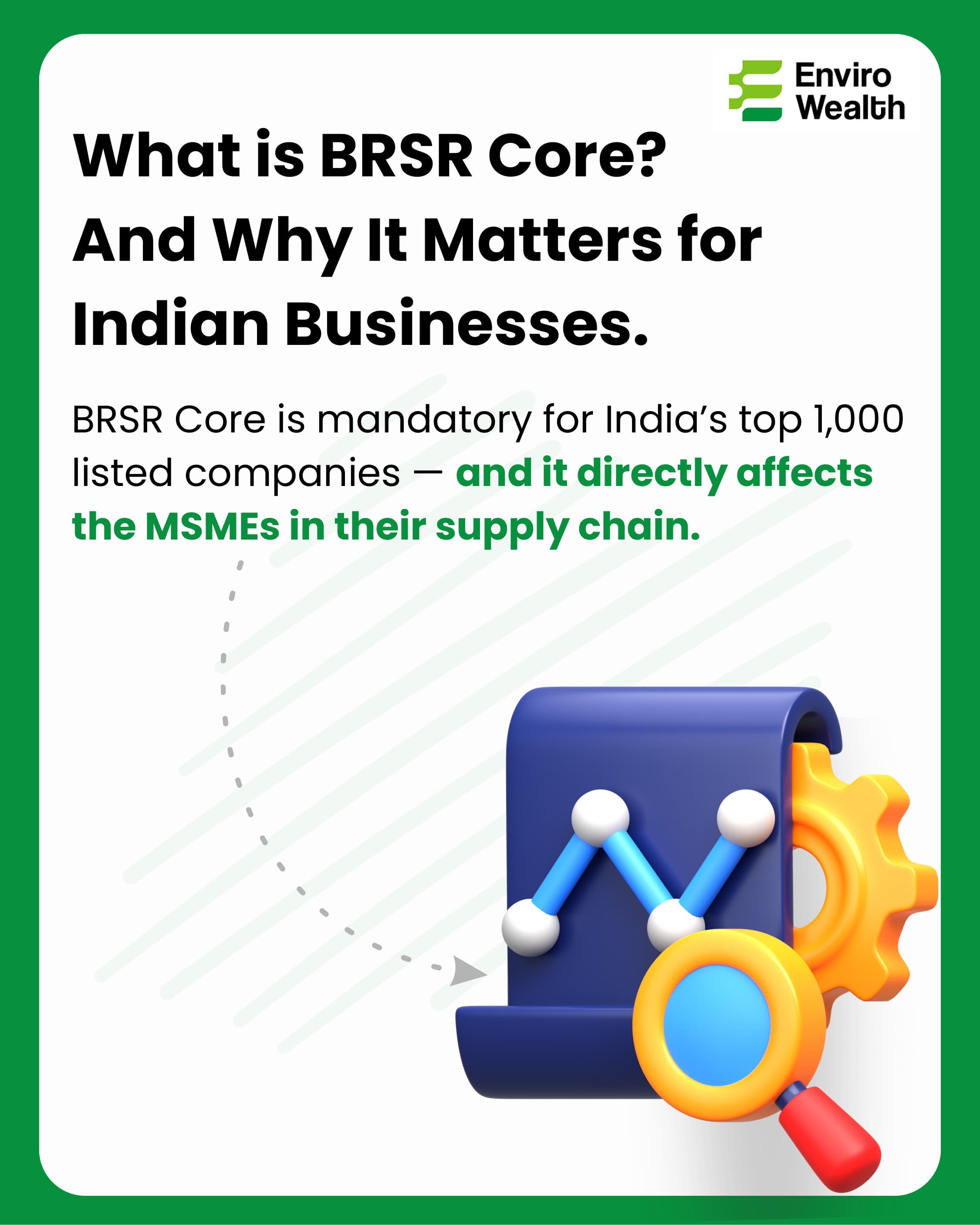
What is BRSR Core? And Why It Matters
Mandatory for India's Top 1,000 Listed Companies & Their Supply Chains
BRSR Core is SEBI's mandatory reporting framework for India's top 1,000 listed firms—and it directly affects every MSME in their vendor network.
Select Card to Inspect:
BRSR Core: India's Auditable ESG Baseline
Introduced to eliminate greenwashing and provide institutional investors with verified sustainability metrics, BRSR Core represents a critical subset of high-priority environmental, social, and governance KPIs requiring independent third-party assurance:
- Regulatory Mandate: SEBI LODR Regulation 34(2)(f) makes full BRSR mandatory as part of the annual report for the top 1,000 listed entities by market capitalization.
- 9 Core Attributes: Spans Greenhouse Gas Emissions (Scope 1, 2, 3), Water Consumption & Intensity, Energy Consumption & Mix, Waste Management, Employee Well-being, Gender Diversity & Equal Opportunity, Inclusive Development, Customer Conduct, and Business Openness.
- Independent Verification: Mandates third-party assessment or reasonable assurance to guarantee that published metrics are audit-grade and tamper-resistant.
Assurance Glide Path
BRSR Core assurance phased in progressively: Top 150 companies in FY 2023-24, expanding to the Top 250 in FY 2024-25, Top 500 in FY 2025-26, and the complete Top 1,000 listed companies in FY 2026-27.
Why India Needed BRSR Core
Before SEBI's standardized framework, corporate sustainability disclosures in India were fragmented, voluntary, and often comprised marketing claims rather than empirical data:
- Eliminating Greenwashing: Replaced qualitative public relations assertions with verifiable, numerical sustainability accounting.
- Attracting Global ESG Capital: International institutional investors (sovereign wealth funds, pension funds) allocate capital based on transparent ESG disclosures.
- Standardizing Reporting: Established a uniform taxonomy aligned with the National Guidelines on Responsible Business Conduct (NGRBC).
- Supply Chain Traceability: Extends reporting scrutiny from corporate headquarters deep into tier-1 and tier-2 vendor ecosystems.
How BRSR Core Directly Impacts Indian MSMEs
Even if an MSME is not listed on the stock exchange, it cannot avoid BRSR Core if it sells to large listed corporations:
- Supplier Footprint Audits: Top listed conglomerates (Tata, Reliance, Mahindra, ITC, Infosys, Asian Paints, Godrej) must calculate their Scope 3 value-chain emissions, requiring primary data from suppliers.
- Contract Disqualification Risk: MSMEs lacking verified energy, carbon, and worker safety records risk losing lucrative annual supply contracts.
- Preferred Vendor Status: ESG-ready MSMEs with auditable sustainability data receive preferential procurement terms, faster vendor onboarding, and long-term contracts.
| Industry Titan | BRSR Supply Chain Requirement | Impact on SME Suppliers |
|---|---|---|
| Tata Group | Responsible Sourcing Policy & Scope 3 audit | Mandatory vendor greenhouse gas disclosure |
| Reliance Industries | Comprehensive ESG reporting across value chain | Energy efficiency & safety compliance required |
| Mahindra & Mahindra | Science-Based Scope 3 supplier decarbonization | Requires verifiable carbon footprint metrics |
| Hindustan Unilever | Sustainable Sourcing Charter | Tier-1 suppliers audited for waste & water management |
| ITC Limited | Triple Bottom Line vendor evaluation | Carbon and water-positive supply chain alignment |
What is BRSR Core? And Why It Matters for Indian Businesses
Official EnviroWealth guide explaining SEBI's BRSR Core standard, the 9 essential ESG indicators, MSME supplier impact, and enterprise adoption.
Key Strategic Takeaways
BRSR Core is SEBI's mandatory, auditable ESG disclosure framework for India's top 1,000 listed enterprises.
It covers 9 essential ESG attributes including greenhouse gases, water intensity, energy, waste, and gender diversity.
Large corporations must report supply chain emissions, directly requiring ESG data from non-listed MSME vendors.
Leading Indian industrial groups now require auditable sustainability metrics before renewing vendor contracts.
EnviroWealth helps MSMEs prepare accurate, verified BRSR Core data to secure their enterprise supplier status.
BRSR Core Preparation with EnviroWealth
Prepare compliant, audit-ready BRSR Core disclosures for your enterprise or provide seamless sustainability reporting to your enterprise customers.
Explore Related Topics
Know the Carbon Terms
Foundational Carbon Glossary Shaping ESG, Exports & Global Trade
What is Carbon Footprint?
How Small Daily Habits & Enterprise Operations Impact the Planet
What is PCF? (Product Carbon Footprint)
Cradle-to-Grave Lifecycle Emissions Accounting for Modern Supply Chains