
What is PCF? (Product Carbon Footprint)
Cradle-to-Grave Lifecycle Emissions Accounting for Modern Supply Chains
Every product manufactured and consumed leaves an environmental trail. Product Carbon Footprint (PCF) quantifies that exact footprint across the entire value chain—from raw material extraction through manufacturing, distribution, customer use, and end-of-life disposal. In an era of EU CBAM and corporate Scope 3 audits, PCF is now a vital passport for international trade.
Interactive Infographic Series
Official EnviroWealth Visual Deck • 5 Infographic Cards
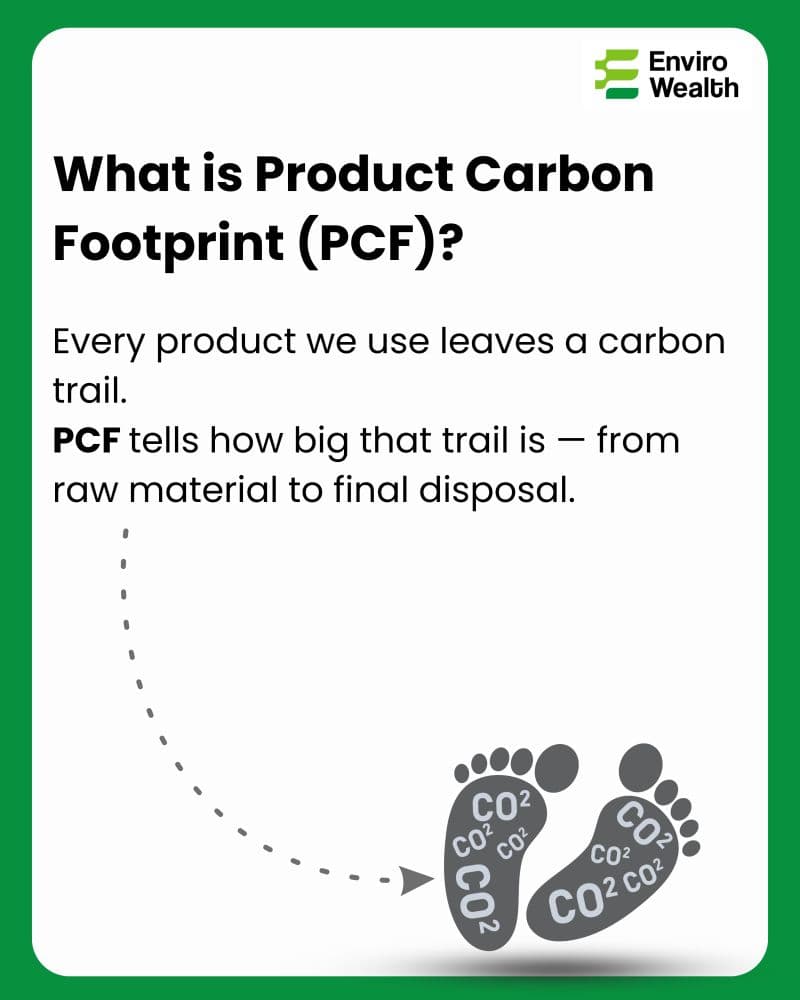
What is Product Carbon Footprint (PCF)?
Measuring the Carbon Trail of Every Product
Every product we use leaves a carbon trail. PCF tells how big that trail is—from raw material to final disposal.
Select Card to Inspect:
The 5 Stages of Product Carbon Footprint Accounting
According to ISO 14067 and the GHG Protocol Product Standard, a comprehensive PCF evaluation maps energy and material fluxes across five distinct phases:
- 1. Raw Material Extraction: Agricultural, mining, or chemical synthesis processes required to harvest foundational inputs. Often represents up to 50% of embodied carbon.
- 2. Manufacturing & Processing: Direct electricity, heating, steam, and chemical reactions inside the factory during part fabrication and assembly.
- 3. Packaging & Logistics: Embodied carbon of corrugated cardboard, plastics, or glass, combined with freight transport emissions (road, sea, air).
- 4. Product Use Phase: Electricity, water, or consumables utilized by the end consumer while operating the product across its intended lifespan.
- 5. End-of-Life Treatment: Carbon dynamics of landfill decay, incineration, recycling reprocessing, or remanufacturing into secondary raw materials.
System Boundaries: Cradle-to-Gate vs. Cradle-to-Grave
B2B industrial components (like automotive parts or bulk steel) are typically calculated on a Cradle-to-Gate basis (ending when the product leaves the factory). Consumer-facing retail goods generally require full Cradle-to-Grave accounting.
Global PCF Standards: ISO 14067 & Pathfinder
To ensure global buyers accept your PCF disclosures, calculations must adhere to standardized international protocols:
- ISO 14067: The gold-standard international specification outlining principles, requirements, and guidelines for quantifying and reporting carbon footprints of products.
- GHG Protocol Product Standard: Detailed accounting guidance for value-chain product footprints aligned with corporate Scope 3 requirements.
- WBCSD Pathfinder Framework: A standardized digital exchange data model enabling multinational corporations to request and ingest verified primary supplier PCFs.
| Standard | Governing Body | Key Application | Auditor Acceptance |
|---|---|---|---|
| ISO 14067:2018 | ISO | Comprehensive product lifecycle quantification | Global / Universal |
| GHG Protocol Product | WRI / WBCSD | Corporate Scope 3 supplier data alignment | Global / CDP |
| Pathfinder Framework | WBCSD PACT | Automated digital supply-chain PCF exchange | Multinational Buyers |
| EU CBAM Rules | European Commission | Embedded emission calculations for imported goods | Mandatory for EU |
Commercial Dividends of PCF Transparency
Measuring PCF is no longer merely a sustainability initiative—it is a decisive commercial lever that wins premium contracts:
- Tier-1 Supplier Qualification: Global multinationals increasingly require certified PCFs before signing annual vendor master service agreements.
- Identifying Hidden Overhead: PCF hotspot assessments reveal machinery running inefficiently, compressed air leaks, and excessive packaging weight.
- Defeating Greenwashing Regulations: Strict anti-greenwashing directives in the EU and UK penalize vague claims like 'eco-friendly'. A certified PCF provides bulletproof, auditable proof.
Key Strategic Takeaways
PCF calculates the total greenhouse gas emissions of a specific product from raw material to final disposal.
The 5 lifecycle stages ensure no upstream supply chain or downstream disposal emissions are concealed.
Global buyers in Europe, North America, and Japan are making verified PCFs mandatory for supplier selection.
Calculating PCF enables manufacturers to uncover operational inefficiencies and reduce material costs.
EnviroWealth provides AI-driven PCF calculations adhering strictly to ISO 14067 and EU CBAM reporting criteria.
Calculate and Certify Your PCF with EnviroWealth
Streamline product carbon footprinting for your industrial parts, packaging, or consumer goods with automated lifecycle assessments.
Explore Related Topics
Know the Carbon Terms
Foundational Carbon Glossary Shaping ESG, Exports & Global Trade
What is Carbon Footprint?
How Small Daily Habits & Enterprise Operations Impact the Planet
What is EU's CBAM?
The EU Carbon Border Adjustment Mechanism & Strategic Exporter Guide